



This article is a section in a much longer paper I’ve written titled “A Theory of Intelligence Metrics: Measuring the Degree of Intelligence in Search.” Full comprehension of this article is going to require the long paper. Even so, there’s enough here that makes sense on its own and also to sketch a promising change in rhetorical strategy for refuting the power natural selection. The point is not to keep putting a designing intelligence (super engineer) in contrast to natural selection (mindless process), but rather to admit that natural selection does have a certain degree of intelligence. The question then becomes does it have enough intelligence to get the job of evolution done. I don’t form a judgment about that in the article below, though my proclivities will be clear in that I cite Michael Behe and Douglas Axe (and of course I have a long record of writings on this topic). We know that a four-year-old child does not have the intelligence to score gold at a Math Olympiad, and we can show that. My point is simply to take that apparatus of measuring intelligence developed in my long paper and then use it as a framework for assessing whether natural selection is really capable of winning the Evolutionary Biology Olympiad.
How intelligent is natural selection? This question raises a prior question: What does it even mean to ascribe intelligence to natural selection and how, if at all, should its intelligence be measured. As it is, our approach to measuring intelligence through information and probability matches up neatly with what Darwinians themselves have said about natural selection acting as a probability amplifier, taking otherwise wildly improbable things and making them plausibly probable.
The most striking statement of this view that I have found in the Darwinian literature comes from R. A. Fisher (1890–1962). Fisher was at once the greatest statistician of the 20th century, a geneticist, a chief architect of the neo-Darwinian synthesis, a devout Anglican, and a fervent eugenicist (seeing eugenics as a religious duty to better humanity). In a chapter for an anthology on evolution (Evolution as a Process, 1954), edited by Julian Huxley among others, Fisher wrote:
[I]t was Darwin’s chief contribution, not only to Biology but to the whole of natural science, to have brought to light a process by which contingencies a priori improbable, are given, in the process of time, an increasing probability, until it is their non-occurrence rather than their occurrence which becomes highly improbable.[1]
This is a truly staggering statement. To the degree that intelligence is understood and measured in terms of probabilities and related information measures, this would make it Darwin’s chief contribution as providing a complete account of intelligence not just in biology but across all the natural sciences. That would be quite the feat! And just to be clear, the referent of Darwin’s chief contribution here is natural selection. Indeed, lest one think that Fisher is describing here something other than natural selection, Julian Huxley, in his introduction to Evolution as a Process, quotes Fisher as saying, “Natural selection is a mechanism for generating an exceedingly high degree of improbability.”[2] The overlap with the earlier quote is unmistakable.
Having quoted Fisher on natural selection acting as a probability amplifier, Huxley immediately expands on what this means for biology. Invoking H. J. Muller, Huxley writes:
We can now … make some quantitative estimate of that degree [of improbability that natural selection is able to generate]. Muller has calculated that the most conservative odds against a higher organism, such as a man, a mammal, or even a fruit-fly, coming into existence fortuitously, without the operation of selection, by the union in one stock of all the necessary mutations, are given by a number with so many noughts that it would take an average novel to write it out, a number immensely greater than that of all the electrons and protons in the visible universe. That is a measure of the degree of our own inherent improbability—an improbability of the same order of magnitude as that of a monkey with a typewriter producing the works of Shakespeare. Just as it took the conscious activity of an outstanding human mind to produce the one, so it took two thousand million years of natural selection to generate the other.[3]
It’s fascinating here to see this juxtaposition of Shakespeare—who in his plays and poems provides as clear a demonstration of purpose and design as exists—with natural selection—which for Darwinists is the singular creative force that calls into being the great complexity and diversity of life. No wonder that natural selection is viewed by Darwinists as the great designer substitute.
Two decades earlier, in 1936, in an article in Nature, Julian Huxley explained exactly how natural selection acts as a probability amplifier and thus as a designer substitute:
We must invoke natural selection whenever an adaptive structure involves a number of separate steps for its origin. A one-character, single-step adaptation might clearly be the result of mutation. But when several or many steps are involved, it becomes inconceivable that they shall have originated simultaneously. The improbability is therefore enormous that they can have arisen without the operation of some agency which can gradually accumulate and combine a number of contributory changes: and natural selection is the only such agency that we know. Natural selection achieves its results by giving probability to combinations which would otherwise be in the highest degree improbable.[4]
Huxley here omits an obvious possibility. What if multiple steps are needed for some feature to evolve but they need to originate simultaneously before natural selection can act, there being no selective advantage for fewer steps? This is the point of Michael Behe’s notion of irreducible complexity: for irreducibly complex systems, several steps need to originate simultaneously, natural selection cannot (except with vast improbability) achieve such simultaneous origination, and there is indeed another agency we know about that is up to the task, namely, real teleological agency, or intelligent design.[5] Nonetheless, if we go with Huxley here, it’s straightforward to see what he has in mind in how natural selection amplifies probabilities and in how an intelligence metric might reasonably be assigned to natural selection.
Consider the case of antibiotic resistance. I’ll offer a stylized example that captures the essence of what Huxley is saying here, with the advantage that the numbers are readily calculable.[6] Let’s imagine we have a million bacteria. Each gets to flip a fair coin twenty times. If it gets 20 heads in a row, it gets rewarded with a mutation that lets it escape death when doused by a given concentration of an antibiotic.
Those that escape death in the first round are allowed to reproduce until they reach a population of a million, at which point they are again handed a fair coin and get to flip it twenty times. If any bacterium does flip twenty heads in a row this second round, it gets rewarded with a second beneficial mutation that allows it to survive now a 100-fold concentration of the antibiotic. And so on for five rounds. Any bacterium that has survived after five rounds now has five mutations that allow it to withstand a 100,000-fold concentration of the antibiotic.
What, then, is the probability that a bacterium evolves via this selection scheme after five rounds? The probability of at least one bacterium out of a million flipping 20 heads in a row in any round is .6147. The probability that some bacterium will survive all five rounds, acquiring five mutations that confer a 100,000-fold increase in antibiotic resistance, is then .0877 (i.e., .6147 raised to the 5th power), or roughly 9 percent.
This is not a huge probability, but it is far greater than the probability of getting five mutations without selection. To see this, consider what would have happened if that original population were doused with a 100,000-fold concentration right from the start. The probability of some bacterium spontaneously acquiring the five mutations needed to achieve this level of antibiotic resistance would then have been equivalent to one of these million bacteria flipping 100 heads in a row in a single trial (5 rounds of 20 heads in a row all by the same population of a million bacteria). That probability would be 1 in 1.27 x 10^24, or in decimal notation .0000000000000000000000007874, which is a decimal with 24 leading zeros.
The relative intelligence of pure chance versus selection is now readily calculated in terms of the various intelligence metrics laid out in the previous sections. For simplicity, let’s just go with active information. Let p = 1/(1.27 x 10^24) (this is the probability of getting the 5 mutations all at once by pure chance) and let q = .0877 (this is the probability of getting the 5 mutations incrementally by selection). The active information is then the logarithm to the base 2 of q/p, which is substantial, namely, 76.56 bits. It indicates that selection is far more intelligent at bringing about the five mutations than pure chance.
The astute reader will note that I dropped the adjective “natural” in front of “selection” here. Strictly speaking, the selection in this example was artificial rather than natural. But I’m happy to concede that artificial selection here can mirror natural selection in the wild as it responds to antibiotics. Consequently, I’m happy also to concede that natural selection in such cases is far more intelligent than pure chance in achieving given levels of antibiotic resistance (especially if we raise the population size from a million to, say, a billion—that would make it virtually assured that antibiotic resistance will develop by selection, but pure chance will still be grossly ineffective).
We need now to remind ourselves of a point stressed throughout this paper: intelligence is task specific and measuring intelligence is a matter of gauging success/failure at achieving specific tasks. Consequently, there is no reason to think that natural selection, even though successful at certain tasks, needs to be universally successful at bridging all evolutionary transitions. It could simply be a fact of biochemistry that certain evolutionary transitions require multiple coordinated mutations. Michael Behe makes that claim for irreducibly complex biochemical systems, as he argued in Darwin’s Black Box.[7] Likewise, he makes that claim for chloroquine resistance in the malarial parasite Plasmodium falciparum, which requires 10^20 parasites for the multiple specific mutations needed to produce resistance, as he argued in The Edge of Evolution.[8]
It is not my aim here to retry Behe’s case for limiting the power of natural selection. My point, rather, is to lay out the logic by which natural selection can be assigned a measure of intelligence that tracks its success or failure at effecting certain evolutionary transitions. Obviously, any legitimate measure of intelligence must be able to capture both success and failure—it can’t just be an a priori truth that such a measure must always and in every way promote the power of natural selection. Any legitimate intelligence metric will measure degrees of intelligence and at the extremes there will be measures of intelligence that signify adequacy as well as inadequacy for the task at hand.
[I]t is illegitimate to argue that when pure chance fails, then natural selection is the only game in town, and so it must be able to raise the probabilities in question even in the absence of evidence for this raising of probabilities…
Mathematician Jason Rosenhouse, in his 2022 critique of probabilistic arguments that attempt to refute Darwinian evolution, rejects the possibility that natural selection may ever be inadequate for effecting certain evolutionary transitions, always acting instead as a fully adequate probability amplifier. In this, he parallels Julian Huxley and R. A. Fisher, who likewise saw natural selection in this role as a universally capable probability amplifier. Writing specifically about the evolution of “complex biological adaptations,” Rosenhouse claimed, “Either the adaptation can be broken down into small mutational steps or it cannot. Evolutionists say that all adaptations studied to date can be so broken down while antievolutionists deny this.”[9]
Again, it’s not my concern here to rehearse the arguments made by critics of neo-Darwinism such as Michael Behe who claim adaptations exist that cannot be broken into small incremental mutational steps subject to natural selection. But I do want to point out that wherever one lands on this question, it is illegitimate to argue that when pure chance fails, then natural selection is the only game in town, and so it must be able to raise the probabilities in question even in the absence of evidence for this raising of probabilities and even when there exist good empirical and theoretical arguments that multiple coordinated changes rather that sequentially advantageous changes are needed.

At the famous 1966 Wistar symposium titled Mathematical Challenges to the Neo-Darwinian Interpretation of Evolution, mathematicians Marcel Schützenberger and Stanislaw Ulam, along with engineer Murray Eden, critiqued the mathematical adequacy of neo-Darwinism in accounting for the full sweep of evolution. In responding specifically to the critique of Ulam, Harvard evolutionist Ernst Mayr remarked: “We have so much variation in all of these things that somehow or other by adjusting these figures we will come out all right. We are comforted by knowing that evolution has occurred.”[10]
This will not do. It’s not enough to say we know that evolution has occurred—by natural selection no less—so it doesn’t matter what the math tells us. Specifically, it’s not enough to say that we know pure chance can’t get the job done so it must be natural selection that’s getting the job done, thereby automatically conferring on natural selection a high probability of effecting a desired and needed evolutionary transition and thus assigning to it a substantial measure of intelligence. Such an argument commits the bifurcation fallacy (aka false dilemma), namely, the error of presenting two alternatives as the only possibilities when at least one other alternative exists. Obviously, intelligent design is such an alternative.
With any task and any process supposedly capable of achieving the task, it is always legitimate to ask what the probability is for the process to achieve the task, and this is true even if estimating such a probability is easy, hard, or infeasible. With natural selection, therefore, there is no need to position it reflexively against the foil of pure chance. Rather, instances exist where natural selection may be considered on its own terms and its probabilistic properties can be evaluated directly.
The point to note is that these improbabilities are not for pure chance but for natural selection.
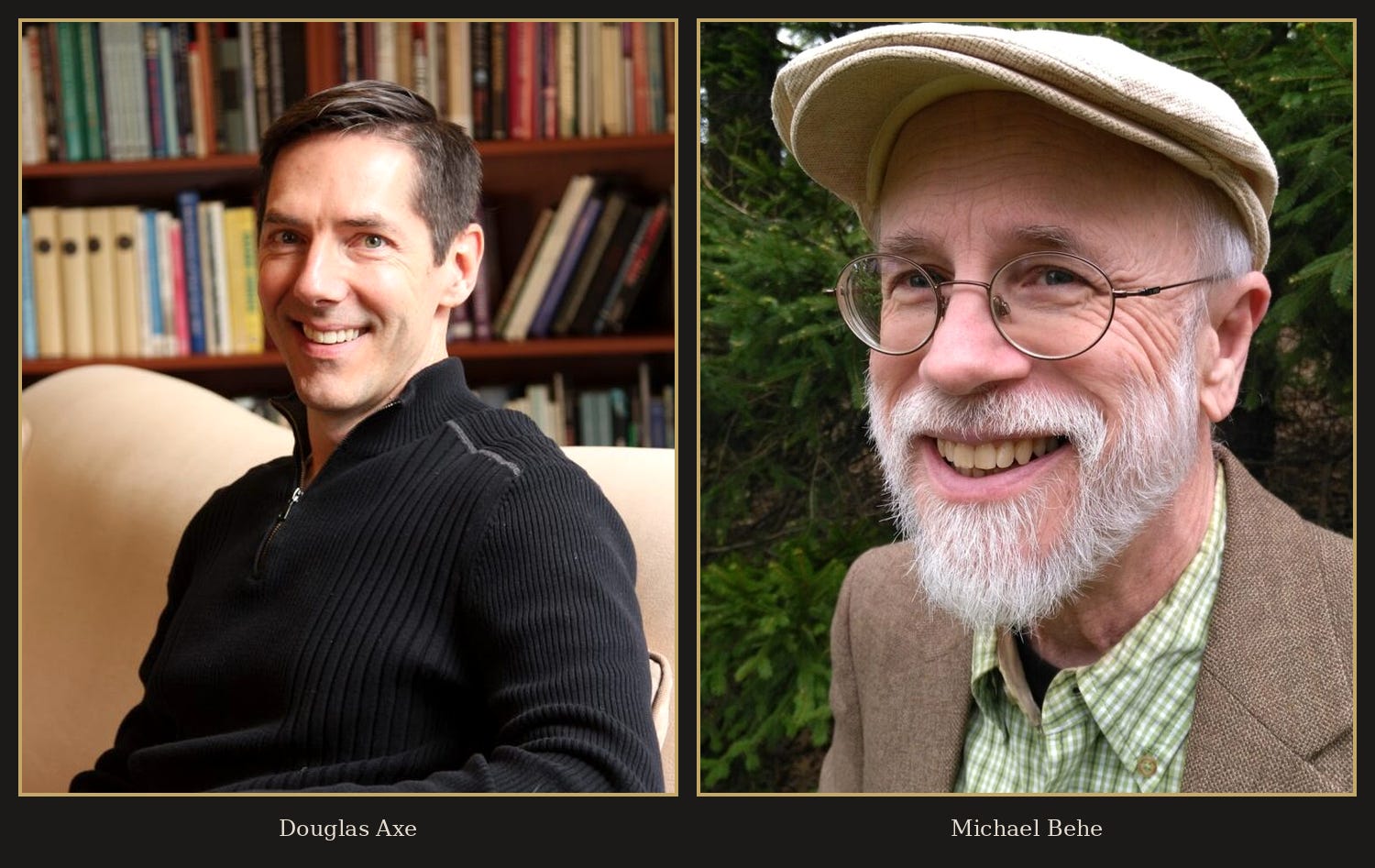
Molecular biologist Douglas Axe’s work on the evolution of beta-lactamase is a case in point.[11] He established a hydropathic signature for this enzyme and then showed that evolving into an enzyme with that signature from some protein with a different function, as must happen if beta-lactamase evolved by natural selection, has a probability in the range of 10^(–64) to 10^(–77). The point to note is that these improbabilities are not for pure chance but for natural selection. Even on the high end in terms of probabilities, Axe estimated that natural selection’s failure rate at 10^(–64). In terms of the intelligence metrics associated with complexity measures developed earlier in this paper, this suggests that an intelligence scoring at least 212.60 bits is required to achieve a functional beta-lactamase.
But note, this measure of intelligence is not assigned to natural selection. Rather, it measures the intelligence needed, over and above natural selection, to achieve a functional beta-lactamase. Just as in some circumstances, natural selection may be needed to surmount pure chance, so in others natural selection may itself need to be surmounted. As described earlier, when a complexity measure assigns a high degree of difficulty to a problem or search, when the problem is solved or the search is successfully completed, the presumption is that the cause or agent that solved the problem or completed the search had the capacity to overcome this level of difficulty and that this level of difficulty can therefore be ascribed to that cause or agent as a measure of intelligence.
Accordingly, in the terminology of this paper, Douglas Axe’s research purported to show that 212.60 bits sets a lower bound on the degree of intelligence beyond natural selection required to achieve a functional beta-lactamase. The underlying measure of intelligence here is active information. But note, the big caveat in all this is one stated earlier in this paper: Intelligence should be credited to an agent or process only in the absence of unfair privileges or advantages contributing to its success and only to the degree that its own capacities account for reaching the target.
In wrapping up this article, let me be clear that I do not claim here to have demonstrated the inadequacy of natural selection or any limitations on its intelligence. For that, the reader needs to consult the wider literature both in defense of and critical of neo-Darwinism. My point here, rather, is to lay out the logic by which natural selection can claim to have its intelligence measured, and then to ensure that natural selection is given no special privileges over any other processes whose intelligence is subject to measurement.
[1] R. A. Fisher, “Retrospect of the Criticisms of the Theory of Natural Selection,” in Julian Huxley, A. C. Hardy, and E. B. Ford, eds., Evolution as a Process (London: Allen & Unwin, 1954), 91.
[2] Julian Huxley, “The Evolutionary Process,” in Julian Huxley, A. C. Hardy, and E. B. Ford, eds., Evolution as a Process (London: Allen & Unwin, 1954), 5.
[3] Huxley, “The Evolutionary Process,” 5.
[4] Julian S. Huxley, “Natural Selection and Evolutionary Progress,” Nature 138 (1936): 571–573.
[5] Michael J. Behe, Darwin’s Black Box: The Biochemical Challenge to Evolution (New York: Free Press, 1996).
[6] For a more realistic example of antibiotic resistance achieved through selection (albeit artificial rather than natural selection), see Daniel Weinreich, Nigel Delaney, Mark DePristo, and Daniel Hartl, “Darwinian Evolution Can Follow Only Very Few Mutational Paths to Fitter Proteins,” Science 312 (2006): 111–114. They examined five specific mutations in beta-lactamase that jointly increase cefotaxime resistance by about 100,000-fold. A factor that complicates the calculation of probabilities here is that the mutations could occur in different orders (5! = 120 different sequential arrangements) and some of the orders preclude the development of this magnitude of antibiotic resistance.
[7] Behe, Darwin’s Black Box.
[8] Michael J. Behe, The Edge of Evolution: The Search for the Limits of Darwinism (New York: Free Press, 2007).
[9] Jason Rosenhouse, The Failures of Mathematical Anti-Evolutionism (Cambridge: Cambridge University Press, 2022), 178.
[10] Paul S. Moorhead and Martin M. Kaplan, eds., Mathematical Challenges to the Neo-Darwinian Interpretation of Evolution, Wistar Institute Symposium Monograph no. 5 (Philadelphia: Wistar Institute Press, 1967), 30.
[11] Douglas D. Axe, “Estimating the Prevalence of Protein Sequences Adopting Functional Enzyme Folds,” Journal of Molecular Biology 341, no. 5 (2004): 1295–1315.
For a definition of intelligence, have a look here, Richard:
https://billdembski.substack.com/p/the-connections-among-information
This work is part of a larger project on intelligence metrics. Such metrics need to operationalize the definition of intelligence. They thus miss that intelligence at its source comes as a full mental package including consciousness and memory. Ultimately, intelligence is an aspect of the mind of God that then gets reflected in creatures made in his image (humanity) and then in the created order generally. With computers and natural selection, we are dealing with derived intelligences, expressing intelligence that is programmed into them. I hope this helps. I have a longer paper on intelligence metrics that I can share with you.
Trade you: https://www.evoinfo.org/minivida