

Mr. Improbability
A silly story to honor March Madness

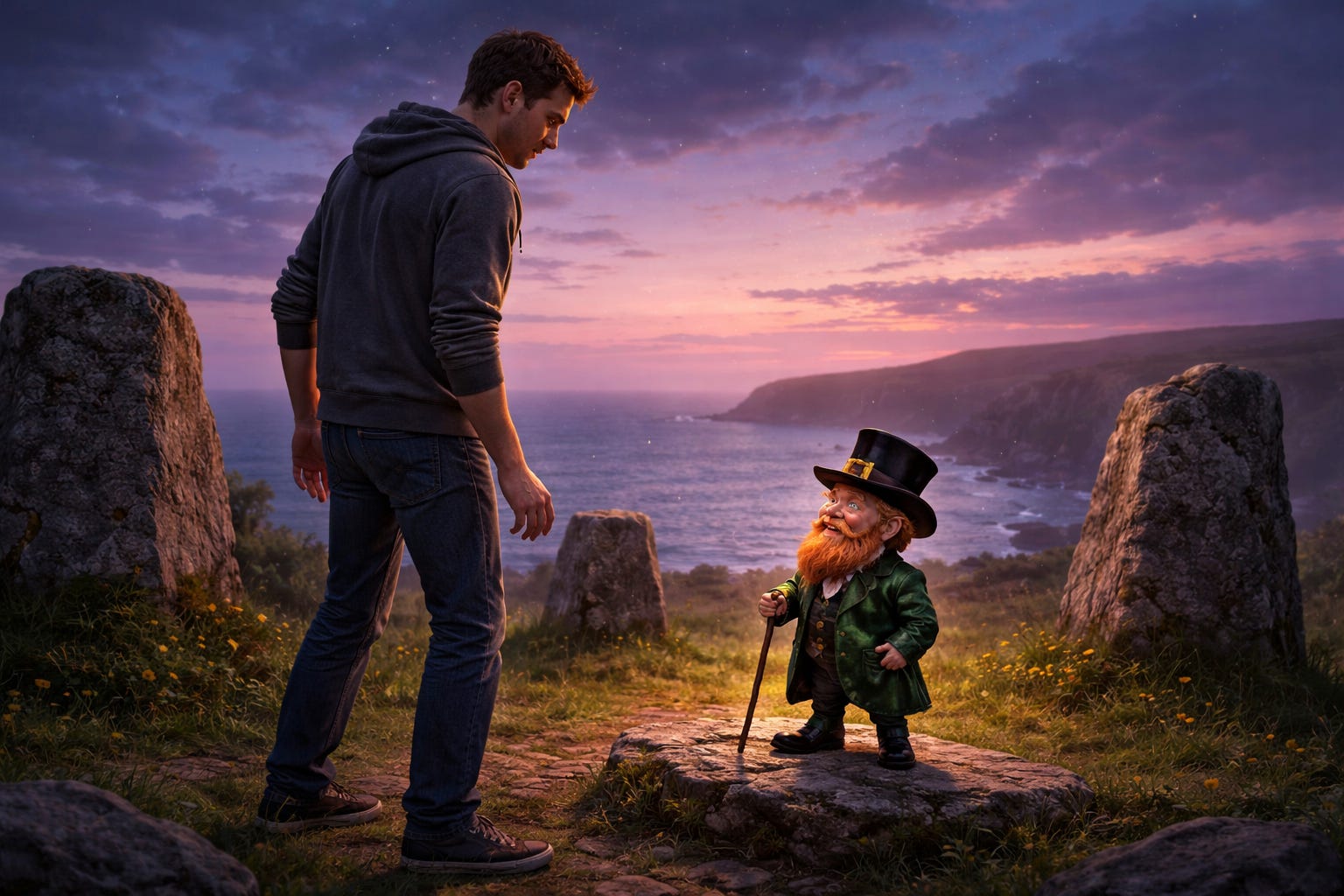
AI Use Disclosure: The author used artificial intelligence in the development of this work.
At six foot six, Liam O’Donoghue had spent much of his life disappointing strangers.
They saw the height first and the rest later. In airports, grocery stores, church parking lots, and restaurants, people always asked, “You play basketball?”
Liam always gave the same answer.
“No.”
The more accurate answer would have been: not successfully.
He was twenty years old, broad-shouldered, long-armed, and naturally unathletic. He could dribble only as the ball directed him. He could not pivot without risk to bystanders or furniture. He had never developed a jump shot, a layup package, or any other part of the game normally associated with height.
His younger sister Kate, who was not tall enough to be asked about basketball by anyone, beat him at HORSE so often that he came to regard basketball as a penance for past sins.
So when Liam met the leprechaun in County Clare, the thing that shocked him most was not the leprechaun.
It was that the leprechaun wanted to talk basketball.
He met him on the second evening of his trip to Ireland, standing in a windy field ringed with old stones. His grandmother, recently dead, had left him one instruction in a note among her things: Go properly. Walk. Don’t hurry. Let the place notice you.
So he was walking.
The sky had not fully committed to night. The water beyond the field looked calm but forbidding. Liam stepped through a gap in the stones and heard a voice behind him say, “I wouldn’t go much farther.”
He turned.
A small man sat on one of the stones with his legs crossed and his hands folded on one knee. He wore a green coat too well tailored to be comic, black boots polished to a military gleam, and a hat that looked less folkloric than rakish.
He was perhaps two and a half feet tall.
Liam stared.
The small man got up and sighed. “Tall people are always last to arrive at comprehension. There’s more distance between the eyes and the brain.”
Liam looked around for hidden cameras.
“Good instinct,” said the little man, “when the impossible is so readily manufactured.”
Liam swallowed. “Are you a leprechaun?”
“I am,” said the small man, “though I resent the tone with which the word is usually spoken.”
Liam decided not to run.
The leprechaun looked him over. “You’re an O’Donoghue.”
“Yes.”
“American.”
“Yes.”
“Six foot six.”
“Yes.”
“Always being asked whether you play basketball.”
Liam blinked. “Yes.”
“Terrible at it.”
Liam hesitated. “Also yes.”
The leprechaun nodded with satisfaction. “Excellent.”
“That last part seems rude.”
“It would be rude if I held it against you. I do not. I value misalignment. A thing is always more interesting when given to the wrong person.”
Liam stood there in the field, trying to decide whether the right response to this creature was respect, skepticism, or a request for medical assistance.
The leprechaun spared him the effort.
“America,” he said, “still likes basketball?”
“Very much.”
“And it still likes odds, prediction, analytics, rankings, percentages, simulations, certainty?”
“Absolutely.”
“Good,” said the leprechaun. “Then I have a gift for you.”
Liam had just enough sense to distrust generosity from beings out of folklore. “What kind of gift?”
“A narrow one. I’m not irresponsible.” The leprechaun raised one finger. “No gold. That ruins people. No immortality. That ruins time. No invulnerability. That ruins narrative. No kingship. That ruins government.”
“What, then?”
The leprechaun smiled. “From this moment on, whenever you make intentional contact with a basketball in genuine attempt to score on a regulation hoop, and the scoring path is physically possible, the ball will go in.”
Liam stared.
“That seems specific.”
“Magic benefits from clear specifications.”
“You mean if I shoot it, I can’t miss?”
“Shoot. Swipe. In any way touch the ball with the intention of making a basket. If the shot is physically possible, it will go in.”
Liam frowned. “Any Intentional contact? Are you kidding?”
“No. Palm it, push it, slap it, tip it, bat it, fling it, volley it, panic at it. If you mean it toward the basket, and the path is physically possible, it will score.”
“So I don’t even need a real shot?”
“A real score is enough.”
Liam considered this. “Why would you do that?”
The leprechaun looked faintly offended. “Because it is funny.”
“There’s no catch?”
“Must everything in your country be either a purchase or a warning? Can no one receive a well-made absurdity without looking for a lawyer behind every bush?”
“I just thought—”
“Yes,” said the leprechaun. “That’s usually the trouble.”
He hopped down from the stone, walked once around Liam as if inspecting him for flaws, and stopped.
“One limit,” he said. “Physically possible means physically possible. I will not detach your shoulder to amuse a crowd. I arrange probabilities. I do not suspend anatomy.”
Then he snapped his fingers.
Nothing seemed different.
No light. No rumble. No scary music. No sensation of power entering Liam’s frame.
The leprechaun nodded. “There.”
“There what?”
“There the gift.”
“Wait,” said Liam. “How do I know—”
But the leprechaun was gone.
Liam stood alone in the field with the wind, the stones, and one yellow flower bending in the grass where the creature had been.
He walked until he happened on a schoolyard court.
By happy coincidence, the gate stood open and a weathered basketball lay under the hoop.
He picked it up, stepped to the free throw line, and shot.
The ball struck back rim, front rim, reconsidered its options, and fell through.
“Fine,” Liam said. “Lucky.”
He stepped back and shot again. Clean.
He moved to the three-point line. In.
He tossed underhand. In.
He turned sideways and shoved it from his hip. In.
Then, because he was alone, he tried something more ungainly. He flipped the ball backward over his shoulder without looking. In.
He stopped shooting and stared at the hoop in disbelief.
Then he resumed. He tried half-formed shots, lunging shots, sideways pushes, flat-handed smacks. At one point he tossed the ball too far ahead, had to leap after it, and merely slapped it with his fingertips in a desperate attempt to keep it alive. The ball rose high, kissed the backboard, and dropped in.
That was when the full inelegance of his gift became clear.
He did not need to shoot well.
He barely needed to shoot.
He needed only to make deliberate scoring contact.
Liam returned to his rented room with the strong sense that nothing in his life was ever going to be the same.
Back in Indiana he told Kate.
She listened with folded arms.
“You met a leprechaun,” she said.
“Yes.”
“In Ireland.”
“Yes.”
“And now any time you touch a basketball trying to score, it goes in.”
“That is the situation.”
Kate nodded once. “Show me.”
At a public court near home she barked one instruction after another.
“Start normal.”
He shot from the arc. In.
“Now wrong hand.”
In.
“Now don’t shoot. Just bat it.”
Liam tossed the ball to himself, slapped it one-handed toward the hoop like a clumsy volleyball player, and watched it arc in.
Kate narrowed her eyes.
“Again. Off balance.”
He stumbled on purpose, half-fell, and swatted the ball upward with the heel of his hand. It hit glass and dropped.
“Tip-in from the side.”
In.
“Don’t catch it at all. Just redirect.”
In.
For an hour she designed indignities and Liam converted them into points. At last she lowered the ball and said, in a tone of deep professional interest, “We’re filming this.”
“No.”
“Yes.”
“It will make everything worse.”
“Of course it will,” said Kate. “But it will also answer the important question.”
“What important question?”
“How much worse?”
The video lasted just over two minutes. It was all one continuous take. Liam in a gray T-shirt on a cracked public court, touching the ball in one increasingly implausible way after another while Kate named the attempts off-camera with clinical calm.
“Backhand it.”
In.
“Tip it left-handed.”
In.
“Don’t catch. Just redirect.”
In.
“From half court, and make it ugly.”
“From full court, and make it uglier.”
Liam chased a bad toss, slapped the ball with an open palm while stumbling sideways, and watched it drop clean through.
Kate posted the clip under the title: My brother went to Ireland terrible at basketball and returned as the greatest shooter of all time.
By morning it had three million views.
Then came the predictable progression of disbelief.
Fake.
Edited.
Magnets.
Deepfake.
Government.
Deeperfake.
Then:
Live stream him.
A local station did.
Liam made shot after shot under studio lights. It’s as though he wanted to be inelegant on purpose. He tipped one in from a rebound angle with both feet planted wrong. He volleyed another off a bad pass. He redirected one from behind his head with the back of his hand.
A former player serving as guest analyst stopped laughing halfway through the segment and said, imitating Chief Inspector Dreyfus, “His form is terrible. He’s the Inspector Clouseau of basketball.”
By evening every network in the country was trying to explain him.
A biomechanics lab found nothing special in his body except conspicuous ineptitude at every skill besides scoring. A statistician on a panel observed that explaining one bizarre basket was trivial; explaining hundreds in sequence was a probabilistic miracle. A physicist at Berkeley proposed that in nearly every universe Liam missed like anyone else, but that we happened to occupy just the right branch where he did not.
This produced the headline that embarrassed Liam most:
ARE WE LIVING IN LIAM’S LUCKY UNIVERSE?
Recruiters called. Agents called. Commentators called. Podcasters called and called. A sports-betting company requested that he never enter their properties. The startup founder of Certainty Architecture tried to enlist him as their mascot.
Liam stayed at Indiana State because he figured his gift could do no worse there than any other place.
Coach Danvers watched Liam in a private gym for eight minutes before saying, “I’ve seen enough.”
Liam had done nothing in those eight minutes except mis-handle the ball, blow a simple layup he did not intend to score, then tip in five impossible attempts from bad angles. So he asked, “Enough good or enough bad?”
Danvers rubbed his jaw. “Both.”
The coach’s questions were practical.
“Can you dribble?”
“Badly.”
“Pass?”
“Define pass.”
“Defend?”
“I can be an obstacle.”
“Can you get open?”
“If I run around erratically like a crazy man.”
“Can you get a scoring touch on the ball if someone gets it near you?”
“Yes.”
Danvers pointed at him. “That’s the key.”
The first scrimmage revealed what needed to happen.
If Liam ever made clean contact on offense, points followed. But defenders, once warned, swarmed him so completely that he often could not get any hand involved. Worse, on defense he was utterly useless.
Danvers stopped the scrimmage, blew the whistle again, and said, “Good. We have an asset and a liability.”
The liability was obvious. Liam was not a basketball player in the ordinary sense. He was a loophole in sneakers. If left unprotected, defenders could crowd him, bump him, deny him, and make normal offense impossible. If left exposed on defense, he actively contributed to the opposition’s confidence.
So Danvers did the sensible thing. He stopped trying to use Liam as a player and started using him as a weapon.
Liam would not start.
He would not be asked to run offense.
He would not dribble in traffic.
He would not remain on the floor long enough for smart teams to hunt him to death on defense.
He would enter in bursts: after timeouts, on sideline plays, on baseline inbounds, at the ends of quarters, in comeback situations, and any time the game became frantic enough for ordinary basketball to thin out.
Most important, the team would stop trying to get Liam a shot.
They would get him contact.
That changed everything.
A proper shooter needs space, balance, and release. Liam needed a fraction of a second and some part of a hand. A driven pass, a lob, a ricochet, a bad rebound, a trapped possession about to die—any of these could become three points if Liam reached it with intention.
Danvers drew up sets that looked less like basketball than like twelve-step interventions. Three screens. One decoy cut. Liam loose near the logo. A pass too high for a catch but perfect for a volleyball-style redirect.
Another play had him slipping through traffic under the basket, not to finish at the rim, but to back-tip a ball over his shoulder from a seemingly impossible angle. In practice he discovered that even a fingertip deflection counted, provided he meant it.
Opponents adapted by assigning a body to him and then another body to the first body. Danvers adapted by assigning two large men to Liam.
Their official position was forward.
Their actual position was witness protection.
One of them was Reggie Miles, six foot eight, cheerful, but gifted with the kind of muscular menace every coach privately appreciates. He made opposing players pay for putting hands on Liam.
“Man,” Reggie told him during one game, “you’re not a scorer. You’re a constitutional crisis.”
The nickname came from a columnist after a December game in which Liam entered with three minutes left, Indiana State down eleven, and proceeded to score fifteen points without once taking what any honest person would call a shot.
One was a corner tip off a hard pass he never controlled.
One was a side-handed slap from twenty-eight feet while being bumped.
One was an inbounds redirect that barely touched his fingers and somehow found a path off the glass.
One was a volleyball-style smack over a defender’s shoulder after a loose ball skipped high.
The columnist wrote: Statistics have finally met their natural enemy. His name is Liam O’Donoghue, though by now the conference may as well call him Mr. Improbability.
Students embraced the name at once.
By January they were wearing green shirts reading INTENTIONAL CONTACT and LOOPHOLE WITH SNEAKERS.
The sport, meanwhile, grew uneasy.
Some teams tried simply crowding Liam. This worked until they learned that crowding him often produced the very chaos from which he profited. An ordinary star suffers when the play breaks. Liam improved. A trapped pass, a ricochet, a ball knocked loose at the wrong angle—these became invitations.
Other teams took a darker route and sent in designated muscle.
This strategy lasted two televised games.
In the first, a reserve forward from Southern Illinois University hip-checked Liam into the scorer’s table before an inbounds play. Reggie introduced him to a screen that made the highlight reel. The refs issued flagrants. The conference office circulated a memo on player safety before sunrise.
In the second, a team tried grabbing Liam whenever he cut toward the ball. Cameras caught it. Commentators, who normally defend rough play with the moral seriousness of bored uncles, called it cowardice. Public sentiment turned so sharply that by the next week roughing Liam had become reputationally expensive. Nobody wanted to be the team that tried to beat a probability freak with hired assault.
So the sport adapted. Referees watched him closely. His team hid him until the last possible moment. Danvers used offense-defense substitutions whenever he could, because on defense Liam remained what he had always been: hopeless.
Indiana State did not become unbeatable. It became terrifying late.
If the Sycamores led by fifteen, Liam was irrelevant. If they trailed by ten with three minutes left, the air changed. A normal three-point specialist still requires a shot. Liam required only a touch. His offensive return per moment was so obscene that it could erase his defensive weakness in short bursts. He was not a star in the full heroic sense. He was a tactical exploit.
America, being America, loved and hated him at once.
Liam wasn’t thrilled about the fame. People handed him babies, bets, tax forms, and fantasy lineups as though his gift might be transferable.
He took Indiana State to the Elite Eight and lost there for the best possible reason: not enough possessions. The opposing coach slowed the game to a glacial pace, denied transitions, rebounded everything, and treated the final two minutes as an anti-Liam clinic. It worked. Liam scored twenty-four points in ten minutes but watched helpless as the clock continued to belong to physics.
Then came the NBA.
The debate around him could reach no firm conclusion.
Some argued that his defensive frailty and inability to play normal offense would limit him at the highest level. Others pointed out that a player who could manufacture guaranteed three-pointers from broken possessions had no historic comparison and therefore no safe ceiling.
Milwaukee took him third overall.
Their general manager explained the decision in one perfect sentence.
“There’s always a compelling reason,” he said, “to bet on certainty.”
Liam’s NBA phase was brief and catastrophic.
The league discovered exactly what college had discovered, only faster and with more money attached. Liam could not survive on the floor for long stretches. Good guards hunted him. Smart offenses dragged him into in action. His basketball fundamentals remained non-existent.
But none of that addressed the real problem.
Late in games, once the floor opened and desperation entered, he broke the geometry.
Down twelve with two minutes left no longer meant what it had meant. An inbounds play, a high pass, a trap, a loose ball, a ricochet toward Liam’s hand—each became a likely three. Not a hopeful one. A likely one. The difference unsettled everyone.
In his sixth game Milwaukee trailed Boston by fifteen with just over two minutes remaining. Then Liam checked in.
He redirected a high pass from the wing.
He back-tipped a scramble off glass.
He slapped in a sideline inbounds play from twenty-nine feet while being closed on by two defenders.
He made half and full court shots.
He volleyball-spiked a trapped ball toward the rim and watched it drop.
He converted seven threes in a little over a minute and a half, the last of them a one-handed airborne deflection near the scorer’s table after getting clipped at the ankle and barely staying vertical long enough to intend the shot.
Milwaukee won by one.
The Commissioner called an emergency meeting the next morning.
What happened afterward was, in its way, inevitable. The league did not claim Liam cheated. It did not accuse him of technological chicanery, fraud, or even sorcery. It said something far more revealing.
It said uncertainty was essential to the game.
That was the heart of it. Liam did not dominate basketball in every sense. He was too bad at too much. But he made one crucial part of the game too certain. High-leverage possessions could no longer be trusted to remain uncertain, and without that, the league began to feel less like sport than accounting.
So the NBA wrote a rule around him without using his name.
No player could participate who, through demonstrated repetitive anomaly, rendered normal probabilistic variation irrelevant to the essential structure of competitive play.
ESPN put that sentence on screen while three retired players laughed so hard one had to remove his glasses and wipe the tears from his eyes.
Kate called Liam and said, “Congratulations. You’ve been banned by a policy you inspired.”
Milwaukee voided his contract, releasing him with public affection and private relief, along with a miserly severance. Attorneys were eager for Liam to take the NBA to court and try to recoup the earnings guaranteed in his contract. But money was never his thing, and he didn’t want the fight that a high-profile lawsuit would bring.
So Liam went home to Indiana and spent three weeks chilling with family and friends. He didn’t touch a basketball.
Then Reggie called.
“You busy?”
“No.”
“Good. Charity exhibition in Chicago wants you.”
“I’m banned.”
“From the NBA,” Reggie said. “Not from joy.”
That line had been supplied by Reggie’s wife.
The exhibition was meant to be one night. It turned into a circuit, then a business, then something close to a new sport. Not basketball exactly. Basketball had too much self-respect to survive Liam whole. This was adjacent. Hoops, courts, angles, obstacles, platforms, redirect panels, moving screens, family crowds, scholarship money, school-gym funding, musicians, engineers, trick-shot artists, retired pros, and children with no investment in the business of established institutions.
They called it The Improbability Games.
At the first Dublin event, held outdoors under strings of lights beside the ruins of a medieval church stood a court along with a band ready to entertain. Liam stood near the baseline before the start and heard a voice at his knee say, “You’ve improved the joke.”
He looked down.
There was the leprechaun in his green coat and polished boots, as though nothing had changed since their last meeting.
“You?” asked Liam.
“Yes,” said the leprechaun. “Still me.”
Liam looked out over the crowd. Kate at the scorer’s table. Reggie talking to two boys by midcourt. His mother in the front row trying to look composed. Children leaning over railings with the hungry faces unembarrassed by wonder.
“They banned me,” Liam said.
“They would,” said the leprechaun. “Institutions dislike narrow certainty unless they own it.”
“You knew that?”
“I knew they would either worship you or regulate you or expel you.” They chose the last.
Liam laughed. “I’m not unhappy, if that’s what you’re asking.”
“Good,” said the leprechaun. “A joke exceeds expectations when it brings delight.”
A volunteer called Liam’s name. The crowd rose, then roared.
The first event was simple. Local children would call Liam’s scores. Any he made funded their school athletics. Any they made themselves counted double.
The first child chosen was a girl with glasses, well-worn shoes, and the expression of a finance minister.
She took the microphone, looked at Liam, then pointed beyond the open side of the venue toward the adjacent church ruins.
“Off the steeple,” she said.
The crowd bellowed.
Liam looked at the steeple, then at the hoop, then back at the steeple. Absurd, yes. Impossible, no. Long. High. Demanding. But not impossible.
He smiled.
The crowd got louder.
He took the ball, climbed the temporary platform built for longer distance attempts, and let it fly.
The ball rose high into the Irish night, struck the steeple with a clean snap, returned in a descending arc, kissed the backboard, and dropped through.
The place came apart beautifully.
Kate bent over laughing. Reggie ran in circles. The band attacked some tune at a breakneck tempo. The girl with the microphone nodded once, as if her expectations had merely been met.
Liam raised both hands, not in triumph but in surrender to the terms of the joke.
That, he thought, was what the NBA had missed.
A made basket is not always an answer. Sometimes it is a wink.
The girl lifted the microphone again.
“Now left-handed over your head,” she said.
The crowd grew still.
Liam caught the next ball, looked once toward the steeple, once toward the hoop, and smiled.
Mr. Improbability, guarantor of certainty, patron saint of absurd causes, and accidental founder of a happier game, obliged.
Inspiring! I wonder if some version of your leprechaun had a talk with a protein who had lots of binding sites that were constantly joining with all the wrong random molecules, and cast a spell so that one site of the poor protein only bound one particular amino acid, and the other site only bound one particular tRNA molecule that just happened to have the anticodon for that particular amino acid in the middle of its mRNA binding domain, thus turning the formerly hapless protein into a professional amino acyl tRNA synthase that rarely if ever mis-matched, and the genetic code was thus born from a world of improbability.