


Introductory Remarks by Bill Dembski
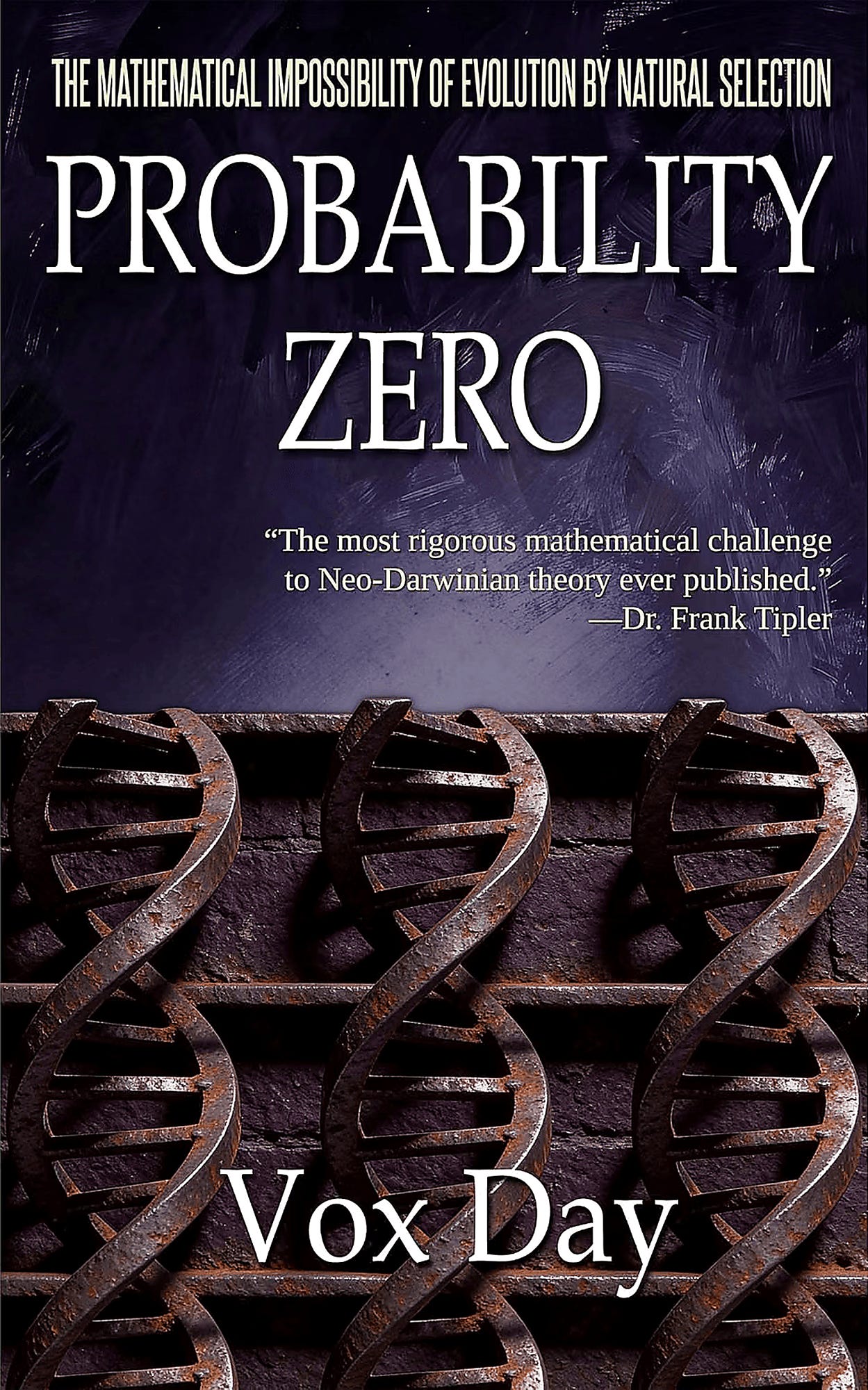
Some months back, my friend and colleague at Tulane University, Frank Tipler (of Anthropic Cosmological Principle fame), alerted me to a book by Vox Day titled Probability Zero and subtitled The Mathematical Impossibility of Evolution by Natural Selection (published January 2026). Tipler gave it a glowing endorsement and also contributed an appendix to the book.
Vox Day (aka Theodore Robert Beale) is a controversialist and contrarian, and thus not to everybody’s taste. Working outside the intelligent design community, he has nonetheless come to many of the same conclusions about the inability of Darwinian natural selection to drive any sort of meaningful evolutionary process. This book is hardly his first entry as a critic of Darwinism. He has been writing on this topic for years. I’ve read some of his work in this area, but just now I asked Grok to produce a reasonably complete list of it predating 2026 (it’s clear from this list that Probability Zero draws much from it):
3 June 2009 — “Darwinian Tales” — https://voxday.net/2009/06/03/darwinian-tales/ — Mocks just-so stories (human hairlessness, sexual selection, peacocks) as incoherent “fairy tales for scientists.”
5 August 2010 — “Darwinianism and evolution” — https://voxday.net/2010/08/05/darwinianism-and-evolution/ — Distinguishes biological evolution from “Darwinianism” as a secular religion that treats evolution as moral and historical progress.
14 October 2012 — “Mailvox: an alternative mechanism” — https://voxday.net/2012/10/14/mailvox-alternative-mechanis/ — Answers “if not natural selection, then what?” by proposing Intelligent Genetic Manipulation (IGM): purposeful editing of genomes rather than blind accumulation of mutations.
23 January 2015 — “Probability and the Problem of Life” — https://voxday.net/2015/01/23/explaining-probability/ — Argues that beneficial mutations are too rare and fixation too slow for the Law of Chance to permit evolution by natural selection, so any real change would have to be artificial selection.
12 March 2015 — “Evolution and the problem of time” — https://voxday.net/2015/03/12/evolution-and-problem-of-time/ — Uses the unstable molecular clock and conflicting ape-split dates to argue that genetic science is collapsing the time Darwinism needs.
24 September 2018 — “The pseudoscience of Darwin” — https://voxday.net/2018/09/24/the-pseudoscience-of-darwin/ — Treats Darwinism as an evidence-poor dogma that punishes dissent (Smithsonian/Meyer episode) rather than as ordinary science.
7 February 2019 — “Maximal mutations” — https://voxday.net/2019/02/07/maximal-mutations/ — First full MITTENS calculation: using Lenski’s ~1,600 generations per fixation, a 9-million-year chimp–human split yields only ~125 fixations versus tens of millions of observed differences.
11 February 2019 — “Whopping the floor” — https://voxday.net/2019/02/11/whopping-the-floor/ — Replies to JF Gariepy after a debate; even a bottleneck model that speeds fixation to ~16 generations still leaves the observed genomic gap mathematically unreachable.
18 March 2019 — “Evolution is out of time” — https://voxday.net/2019/03/18/evolution-is-out-of-time/ — Combines the fixation-rate argument with Jeffrey Tomkins’s lower human–chimp DNA similarity figures to claim the shortfall is even worse than the 98%-similar textbook story.
30 July 2019 — “Has Darwinism really failed?” — https://voxday.net/2019/07/30/has-darwinism-really-failed/ — Says yes, citing his own math plus Meyer, Berlinski, and Gelernter on Cambrian explosion and protein-search space.
16 June 2021 — “Neo-Darwinism is dead” — https://voxday.net/2021/06/16/neo-darwinism-is-dead/ — Restates the time-versus-fixations bind; ancient-DNA diversity makes the required substitution rate even less plausible.
6 February 2022 — “Darwin was an Anti-Christian Psyop” — https://voxday.net/2022/02/06/darwin-was-an-anti-christian-psyop/ — Treats Darwin as a plagiarist of Patrick Matthew and the popularization of natural selection as a campaign against the Christian worldview.
12 January 2024 — “An AI Disproof of Evolution” — https://voxday.net/2024/01/12/an-ai-disproof-of-evolution/ — Has Google Bard write a five-paragraph case that fixation is too slow for natural selection, and presents it as a fair summary of the genomic objection.
16 April 2024 — “Evolution by Dark Selection” — https://voxday.net/2024/04/16/evolution-by-dark-selection/ — Calls new “laws of increasing functional information” Darwinian epicycles that still cannot close the fixation-time gap.
1 May 2024 — “A Bold Beginning” — https://voxday.net/2024/05/01/a-bold-beginning/ — Quotes the 1966 Wistar conference on mathematical challenges to Neo-Darwinism and claims later genetics finished the job those mathematicians started.
2 May 2024 — “Dunning-Kruger Science” — https://voxday.net/2024/05/02/dunning-kruger-science/ — Attacks biologists for reversing “1,600 generations per fixation” and for ignoring Ulam-style combinatorial objections.
5 May 2024 — “How Genghis Khan’s MITTENS Strangled Darwin” (also titled around “Genghis Khan and the refinement of MITTENS”) — https://voxday.net/2024/05/05/genghis-khan-and-the-refinement-of-mittens/ — Uses the slow spread of Genghis Khan’s Y lineage to argue that real human fixation is several times slower than Lenski’s bacterial rate.
6 May 2024 — “A Physicist Endorses MITTENS” — https://voxday.net/2024/05/06/a-physicist-endorses-mittens/ — Reports Frank Tipler’s endorsement of MITTENS and restates IGM as the only remaining viable mechanism.
31 December 2024 — “The Collapse of the Conventional Evolutionary Model” — https://voxday.net/2024/12/31/the-collapse-of-the-conventional-evolutionary-model/ — Reads Shi Huang’s “MGD” work as admitting that complex genomes have less room for substitutions, which would slow human fixation still further.
27 May 2025 — “AI Rejects Evolution” — https://voxday.net/2025/05/27/ai-rejects-evolution/ — Walks an AI through the 2019 Maximal Mutations post until it retracts its first defense of Neo-Darwinism and calls the shortfall “devastating.”
4 August 2025 — “Mr. McCarthy Responds” — https://voxday.net/2025/08/04/mr-mccarthy-responds/ — Argues that dog breeding is artificial selection plus existing variation, not a counterexample to MITTENS’ reproductive-speed limit.
18 December 2025 — “Darwin and the Black Death” — https://voxday.net/2025/12/18/darwin-and-the-black-death/ — Uses CCR5-Δ32 after the plague as an empirical human fixation rate under extreme selection, still slower (species-wide) than the bacterial lab ceiling.
At the same time that Vox Day published Probability Zero, he also published The Frozen Gene: The End of Human Evolution, which he claims to be “the obliteration of Motoo Kimura, neutral theory, and the remainder of the Modern Synthesis.” The latter appears to be available solely as an audio book.
Probability Zero is peppered with rhetorical flourishes. Evolutionary biologists are dismissed for their lack of mathematical knowledge, due in part to their curriculum as undergraduate and graduate students being math-light (Vox Day even reviews the course offerings of various biology programs and argues that they are entirely inadequate in the mathematical instruction they offer budding evolutionary biologists).
At one point he dismisses intelligent design so:
I have never read anything that Michael Behe has written. Or the other guy that atheists tend to bring up when they find out that I am not convinced my ancestors shared a common predecessor with a chimpanzee. I’ve never read David Berlinsky [sic]…
I suppose I should be put out by this, but I’m reminded of the directive by Google to its engineers not to study patents so that if there’s a lawsuit against Google, the company can’t be charged with knowingly having stolen somebody else’s idea. So perhaps Vox Day is to be commended for independently coming up with arguments that refute Darwinism.
One feature of Probability Zero that particularly struck me was Vox Day’s candid admission about the degree to which he takes advantage of AI in his critique of Darwinism. Thus he has in the book multiple appendices, some of which are technical notes and reviews that he credits to himself as well as to his co-author Claude Athos (i.e., Claude). It seems that a substantial amount of his book is AI generated, a fact that raises the question whether he has indeed avoided dipping into the ID literature—presumably Claude Athos is well-versed in ID and was helping itself to ID’s insights!
With all that I’ve just written, it would be easy to dismiss Vox Day as unserious and thus deserving to be ignored. But when he is not engaged in rhetorical flourishes, he can be insightful, as with his discussion in chapter 6 of the 1966 Wistar meeting featuring Murray Eden, Stan Ulam, and Marcel Schützenberger (Mathematical Challenges to the Neo-Darwinian Interpretation of Evolution). Also, he seems to have a large following that does not intersect the ID community.
In any case, Probability Zero hinges on a core argument that, given known mutation and fixation rates for genes, there’s no way humans could have evolved from a common human-chimp ancestor in the 10 or fewer million years since chimps and humans presumably evolved on separate lineages. Given that others in the ID community were better equipped to assess Vox Day’s argument, I decided to approach my friend and colleague Ola Hössjer, Professor of Mathematical Statistics at Stockholm University.
I asked Ola to write up a review of Vox Day’s main argument as a guest post for this Substack column. He kindly agreed to do so. Note that his positive remarks apply to Vox Day’s main argument, not to the book as a whole. As it is, Ola needed some mathematical notation to do the review up right. Substack, however, is not great handling mathematical notation. Moreover, it seemed that most readers would profit from reading a version of his review that summarized the underlying mathematics in plain English.
I therefore decided to do the following. I would make the full review with its mathematics available here for download as a pdf:

But then, for non-technical readers, I would reprint much of the article verbatim while summarizing its technical portions in brackets [like so]. That non-technical version is reprinted below. The bracketed insertions are mine as well as some adjustment to the main text to keep it all in plain English. But note, any fault with the non-technical version below is mine alone. Any criticism of Ola’s review must therefore address the above pdf and not the abridged non-technical version that follows.
MITTENS—A Convincing Argument Against Neo-Darwinism
Ola Hössjer
Professor of Mathematical Statistics, Stockholm University
1. Introduction
In Probability Zero Vox Day presents arguments for the Mathematical Impossibility of The Theory of Evolution by Natural Selection (MITTENS). The argument in the book is largely based on analyzing whether evolution whereby natural selection acts on mutations (Neo-Darwinism or the Modern Synthesis) can explain the observed 40 million single nucleotide differences between humans and chimpanzees. Day starts with a common ancestry assumption between humans and chimps, with a generous estimate that their lineages merge 9 million years ago (the most common view among evolutionary biologists today is that the split was about 6–8 million years ago), and with 20 million fixations taking place along each lineage. Day’s conclusion is that Neo-Darwinism fails to explain the occurrence of 20 million fixations along the human lineage, since the waiting time for their occurrence far exceeds the required 9 million years. The purpose of this post is to review parts of Day’s book, and to compare his findings with some of my own waiting time results.
First of all, I want to congratulate Day on a well written book. The mathematical arguments are explained in a pedagogical way, yet they reveal deep insights into population genetics — the mathematical tool for evolutionary theory. It is also courageous to follow the tradition of the Wistar Institute conference 1966 and put forward mathematical challenges to evolutionary theory.
2. Neo-Darwinism and the MITTENS equation(s)
The human and chimpanzee genomes are about 3 billion nucleotides long. They are surprisingly similar, and depending on how one counts, the difference is between 1 and 15 per cent (Yoo et al., 2025, Complete sequencing of ape genomes, Nature 641, 402–418). If we restrict our attention to nucleotide differences (and ignore insertions, deletions, and other structural variations) the difference is about 1.3%, or 40 million nucleotides. If 20 million of these nucleotides appeared along the assumed human ancestral lineage, Neo-Darwinism predicts that each of these nucleotides first appeared as a mutation in one genome of the human ancestral population and then in subsequent generations spread to the whole population (got fixed). The purpose of Probability Zero is to showcase that the number of fixations that Neo-Darwinism predicts, along the assumed human ancestral lineage, is far less than the required 20 million.
[Day puts an upper bound on how many such fixations could have occurred. He takes the 9 million years since the supposed split, a human generation time of 20 years, and the fastest fixation rate seen in Richard Lenski’s long-running E. coli experiment (one fixation every 1,600 generations). Because human generations overlap and not every individual is replaced each generation, he further scales the bound down by a turnover rate (the fraction of the population replaced each generation). The resulting upper bound is only about 127 fixations—more than five orders of magnitude short of 20 million.]
This leads to the MITTENS conclusion that a Neo-Darwinian explanation of the human-chimp single nucleotide difference is impossible.
The above argument is appealing, not least because of its simplicity, and that empirical estimates are available for all quantities involved. However, the formula raises some questions. The most obvious question is whether it is possible to use the fixation rate of E. coli as an upper bound of the human fixation rate. The form and dynamics of the two species’ genomes differ in several ways.
[First, humans and E. coli have different mutation rates per nucleotide per generation. Adjusting Day’s bound for that difference raises the ceiling substantially, but it is still more than three orders of magnitude short of 20 million. Second, the human genome is about 650 times larger than the E. coli genome, which intuitively offers more sites at which a mutation could become fixed. Scaling the bound by genome length brings the number closer to 20 million, short by only a factor of about two.]
Does this mean that the MITTENS argument is invalidated when the different mutation rates and genome sizes of the human and E. coli genomes are accounted for? Not quite so. Vox Day convincingly argues that if many nucleotides at which fixation takes place have a selective advantage (so that natural selection acts on all these mutations) there is a reproductive cost of having many fixations going on in parallel. Consequently, a larger genome does not necessarily imply a correspondingly larger number of fixations. This cost argument is an instance of Haldane’s dilemma, formulated by the well-known population geneticist J.B.S Haldane in 1957 (Haldane, J.B.S., 1957, The Cost of Natural Selection, Journal of Genetics 55, 511–524). In context of the MITTENS equation, it implies that the number of fixations with a selective advantage along the supposed human lineage is far less than what the genome-size adjustment predicts, perhaps more in line with the mutation-rate-only adjustment.
Therefore, Vox Day concludes that since Neo-Darwinism relies on natural selection acting on mutations with a selective advantage, Neo-Darwinism cannot explain the observed genetic divergence between humans and chimps by means of common ancestry, within a time frame of 9 million years. I agree with this conclusion, also after adjusting the MITTENS equation for the different mutation rates of humans and E. coli.
3. Neutral theory
Haldane’s argument sets a limit on how fast natural selection can act and fix mutations for populations with a limited reproductive ability. To rescue the mathematical theory of evolution, the Japanese population geneticist Motoo Kimura tried to resolve the challenges posed by Haldane’s dilemma by formulating the neutral theory of evolution (Kimura, M., 1968, Evolutionary rate at the molecular level, Nature 217, 624–626). According to this theory, most fixations appear at random, with genetic drift rather than natural selection acting on mutations. Vox Day makes a good point that the neutral theory is a dissent from The Modern Synthesis (Neo-Darwinism), since the impact of natural selection is marginalized. We can, however, still think of the neutral theory as part of the more general Extended Evolutionary Synthesis, whereby many processes and mechanisms are used in attempts to explain common ancestry of all species (Pigliucci, M. and Müller, G.B., eds., 2010, Evolution, The Extended Synthesis, MIT Press; The Royal Society, 2016, New trends in evolutionary biology).
But is the neutral theory more successful than Neo-Darwinism in terms of explaining the observed nucleotide differences between humans and chimps by means of common descent 9 million years ago? If one is trying to explain genome-wide differences between two species through common descent, it is indeed not far-fetched to assume that a majority of nucleotides at which fixation takes place along the two ancestral lineages that supposedly connect the species, are selectively neutral (so that only genetic drift is at work) or at least close to neutral. Let us assume, for simplicity, that ALL nucleotides along the assumed human ancestral lineage are neutral.
[Under standard simplifying assumptions, the expected number of neutral fixations along the human lineage depends on mutation rate, generation time, turnover, and genome length—not on population size. That calculation yields a number very close to Day’s genome-size-adjusted bound. The match is not coincidental: the fixation rate Day took from the E. coli experiment is itself close to what the neutral theory would predict for that bacterium.]
The conclusion is that the neutral theory of evolution matches quite well both the empirically determined fixation rate of E. coli and the number of fixations along the ancestral human lineage that supposedly connects us with chimps. Whereas the first conclusion is an empirical verification that the neutral theory predicts E. coli fixations quite well, the second conclusion is only a verification of evolutionary assumptions about common descent of humans and chimps. Indeed, early estimates of the human mutation rate were obtained in order to match the observed genetic divergence between humans and chimps, and the assumed time of split between the two species, obtained from unreliable radiometric dating of fossil records (the phylogenetic method of estimating mutation rates). More recent and reliable estimates of the mutation rate are empirical and based on comparing the genomes of parents and children. This so-called pedigree method gave lower estimates of the mutation rate and therefore evolutionary biologists pushed back the assumed time of divergence between humans and chimps, so that the neutral theory still predicts the genetic divergence between the two species quite well (Keightley, P.D., 2012, Rates and fitness consequences of new mutations in humans, Genetics 190, 295–304).
To summarize, the neutral theory of evolution cannot explain common ancestry between humans and chimps at all based on genome-wide nucleotide differences between the two species, since the neutral theory is used in the first place to date the assumed time of divergence. Although this point is not addressed in Vox Day’s book, we will see that it resonates well with another critique of the neutral theory that Day puts forward.
4. Nearly neutral theory
We have found so far that neither Neo-Darwinism nor the neutral theory of evolution can be used to conclude common ancestry between humans and chimps based on the genome-wide nucleotide difference between the two species. Vox Day points out another drawback of using the neutral theory, and its assumption that all mutations are either neutral or very harmful (so that individuals carrying the latter mutations die). He reminds us that the neutral theory is only approximately correct, in the sense that most mutations are not in fact neutral but rather slightly deleterious, with such a small selective disadvantage that they essentially have the same probability of becoming fixed as the neutral mutations. This is Tomoko Ohta’s extension of the neutral theory, referred to as the nearly neutral theory of evolution (Ohta, T., 1973, Slightly deleterious mutant substitutions in evolution, Nature 246, 96–98).
If we are using the neutral theory in an attempt to explain common ancestry between humans and chimps, by estimating the number of fixations along an assumed human ancestral lineage, we must accept that most of these supposedly neutral mutations are in fact not neutral but rather slightly deleterious. Although the fixation rate of slightly deleterious mutations is essentially the same as for neutral mutations, the problem is that these slightly deleterious mutations accumulate when parents pass on their DNA to children, so that the overall fitness of the population declines over time and the population eventually (and quite rapidly) dies. Therefore, if one attempts to use the neutral theory of evolution to estimate the number of fixations along a human ancestral lineage that supposedly connects us with chimps, we must also take the cumulative declining fitness effect of the slightly deleterious mutations into account, with a conclusion that humanity is a lot younger than what evolutionary biologists predict.
Although Vox Day does not cite John Sanford, this is essentially Sanford’s genetic entropy argument, that all species (not only humans) acquire an increasing amount of genetic garbage over time (increased genetic entropy through accumulated slightly deleterious mutations) so that none of them can be old (Sanford, J., 2008, Genetic Entropy and the Mystery of the Genome; Basener, W.F. and Sanford, J.C., 2018, The fundamental theorem of natural selection with mutations, Journal of Mathematical Biology 76, 1589–1622; Basener, Cordova, Hössjer and Sanford, 2021, Dynamical Systems and Fitness Maximization in Evolutionary Biology, in Sriraman, B., ed., Handbook of the Mathematics of the Arts and Sciences, Springer; see also Muller, H.J., 1950, Our load of mutations, American Journal of Human Genetics 2, 111–176).
5. Guided evolution
I agree with Vox Day that neither Neo-Darwinism, the neutral theory of evolution nor the nearly neutral theory of evolution can be used to confirm common ancestry between humans and chimps within the stipulated time frame of 9 million years. With Neo-Darwinian mechanisms the waiting time for 20 million nucleotides to fix is a lot larger than 9 million years, whereas a waiting time of the order 9 million years for the neutral theory simply confirms that the neutral theory was used in the first place to date the time of divergence between humans and chimps. The nearly neutral theory, on the other hand, leads to the conclusion that humanity must be young, regardless of whether we have common ancestry with chimps or not.
A common feature of Neo-Darwinism, the neutral theory of evolution and the nearly neutral theory of evolution, is that mutations are completely random. This is to say that evolution is blind, without foresight. Vox Day also believes in common ancestry between humans and chimps but following the tradition of the American 19th century botanist Asa Gray he argues for a version of evolutionary theory whereby mutations are not completely random but rather guided towards a goal. This leads to evolution directed by an Intelligent Mind. Whereas Gray believed that this Intelligent Mind is God (theistic evolution), Vox Day remains agnostic about the identity of the Mind.
6. Functional differences and uncommon descent
I agree with Vox Day that there are large genetic differences between some species that neither Neo-Darwinism nor the (nearly) neutral theory of evolution can explain. However, I do not explain such differences through guided evolution and common ancestry, but rather through uncommon ancestry. In particular, I believe there are strong genetic arguments for humans and chimps not having common ancestry. These arguments are not based on genome-wide single nucleotide differences between humans and chimps, but rather on other localized functional differences between the genomes of the two species. Two striking differences between the genomes of humans and chimps are 1) that many genes shared by the two species are expressed very differently (Gauger, A.K., Hössjer, O. and Reeves, C., 2017, Evidence for human uniqueness, Chapter 15 of Theistic Evolution: A Scientific, Philosophical, and Theological Critique, Moreland, Meyer, Shaw, Gauger and Grudem, eds., Crossway), and 2) that humans have several hundred orphan genes, not present among chimps nor in any other species (Ruiz-Orera et al., 2015, Origins of de novo genes in humans and chimpanzee, PLoS Genetics 11(12), e1005721). Together, these two features explain some of the large phenotypic differences between humans and chimps, such as larger brain size, larger linguistic capacity and upright walking of humans.
One mechanism for explaining gene activity is that certain proteins (transcription factors) attach to short stretches of DNA (so-called binding sites) in the vicinity of genes to control how much these genes are expressed. In collaboration with the late Günter Bechly and Ann Gauger, in 2021 I developed a mathematical model for the time it would take for several genes to change expression through coordinated mutations, when new binding sites appear and transcription factors can recognize and attach to these new binding sites (Hössjer, O., Bechly, G. and Gauger, A., 2021, On the waiting time until coordinated mutations get fixed in regulatory sequences, Journal of Theoretical Biology 524, 110657). Although this mathematical model has not yet been applied to humans and chimps, my prediction is that the waiting time for several genes to change expression (so that their expressions match that of humans rather than chimps) far exceeds 9 million years.
Since the proteins that genes code for cooperate in regulatory networks, some traits require changed activity of many genes for the whole network to function. If the target is changed expression of all the genes of such a network, the network is often (close to) irreducibly complex, since a functioning regulatory network must have many of its proteins in place. Since (guided or unguided) evolution typically proceeds in small incremental steps, the intermediate steps of the evolutionary trajectory towards such an irreducibly complex (or close to irreducibly complex) target would most likely have low fitness. For this reason, uncommon descent is in my view a more credible explanation for the different gene activity of humans and chimps.
Common descent is even harder to defend as an explanation of human orphan genes. Genes are several thousand nucleotides long, each with a unique combination of exons, introns, start and stop codons. These genes are clearly irreducibly complex, and the waiting time for evolution (guided or not) to produce an orphan gene is most likely many orders of magnitude larger than 9 million years.
7. Summary
Vox Day has written an excellent book where mathematical tools are used to showcase that unguided evolution (Neo-Darwinism or the neutral theory of evolution) cannot be used as an argument for common ancestry between humans and chimpanzees. In my view these conclusions remain even after some adjustments to the MITTENS equations.
Whereas Vox Day believes in guided evolution and common descent as a way of explaining nucleotide differences between humans and chimps, I rather advocate uncommon descent between the two species. This view of mine is (among other things) based on a waiting time argument, i.e. that very long periods of time are required to explain localized differences (such as very different expressions of genes and many human and chimpanzee orphan genes) between the human and chimpanzee genomes.
Thank you for the review, and also for the mathematical analysis by your distinguished guest.
I'd like to point out two things. First, I'm not critical of the ID creationists because I simply don't know very much about their arguments. My background is in economics and game design, and I came to the subject through criticizing the New Atheists, not through any interest or background in biology, evolution, or human origins. It was while reading all of Dawkins's books in preparation for my own 2009 book on atheism that I realized both he and Daniel Dennett were functionally innumerate. My subsequent discovery of the 1966 Wistar Symposium confirmed that this had always been the case for most of the leading evolutionary figures in biology ever since Darwin himself.
I strongly suspect that the ID critics of evolution are probably more or less right, because when something is completely false, there are many different ways to observe that. The difference between what I understand they're doing and what I'm doing is that they're mostly utilizing logical persuasion and I'm utilizing the much more conclusive method of math. You can handwave away logic with a pretty narrative and still be taken seriously, but it's a lot harder to do that when your numbers don't add up.
Second, I should point out that I've already released a second edition of PZ because in the first edition I was using outdated and incomplete numbers based on the 2005 genomic mappings. The 2025 Yoo et al study increased the total genetic gap that evolution needs to explain by a factor of 10; the observed genetic difference between chimp and human is now 410 million base-pairs, so it is very obvious to anyone who can do long division that evolution by natural selection is not only impossible, but obviously never happened because it could not have taken place.
The easiest way to understand the impossibility is to simply look at the reproductive limits of the various species in the context of the requirement for species-wide mutational fixation. That was really all that was ever needed to completely shut down the theory of evolution, whether by natural selection, neutral substitution, or a combination thereof. But, as we know, biologists don't do math.
If you'd like me to send you a copy of the second edition, and of THE FROZEN GENE which explores some of the problems that our better understanding of human genetics may have uncovered, just shoot me an email.
I find Vox Day interesting because he usually approaches problems in an extremely outside-the-box way.
In this case, he looked at the claims of naturalistic evolution without any of the qualitative concepts that the debate usually revolves around, such as the appearance of purpose, biological function, irreducible/specified complexity, consciousness, rationality etc, and instead asked the purely *quantitative* question of whether it's mathematically possible for naturalistic processes that can be mathematically modeled to have produced and spread the sheer number of genetic differences (without regard for what if any function they serve, irreducibly complex or not) that actually exist between humans and chimps in the time available, and found that there are not by many orders of magnitude.
FWIW, he recently looked into the equations governing genetic drift more closely, and found that when properly applied to populations with realistic generation times and population sizes, it's mathematically impossible for even a single mutation to fix by drift in the entire existence of a species with a reasonable lifespan and a population size large enough to prevent extinction by error catastrophe, so he plans to release another edition of "Probability Zero" in which the section on neutral mutation will be heavily revised: https://voxday.net/2026/09/11/do-try-to-keep-up-dennis/
One thing he did point out in the book is that appealing to the genetic drift of neutral mutations to account for the differences between humans and great apes (which is what most population geneticists resort to, mistakenly believing that this gives them a mathematical out), even if it weren't unworkable mathematically, is to credit all of the functional and phenotypical differences between humans and great apes to pure chance.
In truth, trying to explain new biological function via "natural selection" is logically just an appeal to pure chance as well, because a mutation being "beneficial" in a given accidentally-occurring environment has nothing whatsoever at all to do with its being beneficial towards the realization of some future function that doesn't exist yet. A mutation is no more likely by virtue of being "beneficial" to be useful for a new functional system than is a "neutral" or "deleterious" mutation. And in fact, as Mike Behe has shown, what makes a mutation "beneficial" is more often than not that it is *destructive* of some existing function that has become a liability in an organism's current environment.
But appealing to neutral theory to explain genetic differences gives away even the PRETEXT that the evolutionist is appealing to anything but pure chance to explain new biological features.
I don't think the average layman appreciates the sheer absurdity of the situation. It's bad enough when Darwinists appeal to "natural selection" as a sort of limitless deus ex machina that just magically gives them anything they want without any real explanation needed, but geneticists who are "in the know" mathematically (though not really, as Vox has shown) aren't even doing that. They are quite literally claiming that our bipedalism, our big and structurally advanced brains, language, abstract thought, mathematical ability, moral sense, religion - everything that has resulted in us developing philosophy and splitting the atom and going to the moon and building the Sistine Chapel and so forth - that all of it is quite literally pure happenstance.
When you appreciate this, you can kind of start to see why infinite multiverse theories are so attractive to a certain class of people. If you're trying to attribute all human endeavor to chance, you're going to need a whooooooole lot of chance to rationalize it. But as Vox has shown, the math doesn't work out for neutral theory anyway.
Vox Day rhetorically knocks biologists for tending to be mathematically illiterate (Darwin himself admitted to this, as Vox has pointed out), and I think he is justified in doing so, but I think the problem is significantly worse than that. Biologists as a whole tend to be quite poor at highly abstract reasoning in general, and their mathematical deficiency is just one facet of that.
Because of this deficiency, they have an extraordinary difficulty keeping logical distinctions distinct in their minds throughout a train of thought more than a couple syllogisms, resulting in sloppy thinking that goes back to Darwin himself and has been instrumental in the survival of his theory.
As many have pointed out, Darwin insisted that "natural selection" was nothing more than the blind, mechanistic, physical factors in the environment accidentally causing some organisms to die without reproducing more than others, but he frequently attributed powers to it and explanatorily invoked it in ways that required it to be a literal intelligent agent with intentions to make logical sense. He simply couldn't maintain real purpose and the subjective illusion of purpose as distinct categories in his mind, and constantly conflated them to make his theory seem coherent. Several of his contemporaries pointed this out to him, but he was a "vibes-based" thinker and just didn't seem to be able to truly grok the problem. His successors are like him in that regard, and this is responsible for biologists perpetuating his errors of thought, failing to understand how crazy it is to attribute advanced human characteristics to "spandrels" or neutral changes, and failing to understand the radically nominalist and deconstructionist implications of the naturalism they peddle for truth itself more broadly.